Commercial and industrial buildings we arrange demolition for
Commercial demolition in Bundaberg is a different job from a house. The buildings are bigger, the structures are steel and concrete rather than timber and fibro, the asbestos is in more places, and the paperwork runs through WHSQ, council engineering and sometimes a traffic management plan. The region's building stock reflects its history: a town that grew on sugar, with Millaquin at East Bundaberg from the 1880s and the Bundaberg Rum distillery from 1888, has mill sheds, cane barracks, rail-side warehouses and tin-and-timber workshops that are now in the way of something new.
- Shops and shopfronts in Bourbong Street and the suburban strips, including strip-outs behind a retained facade
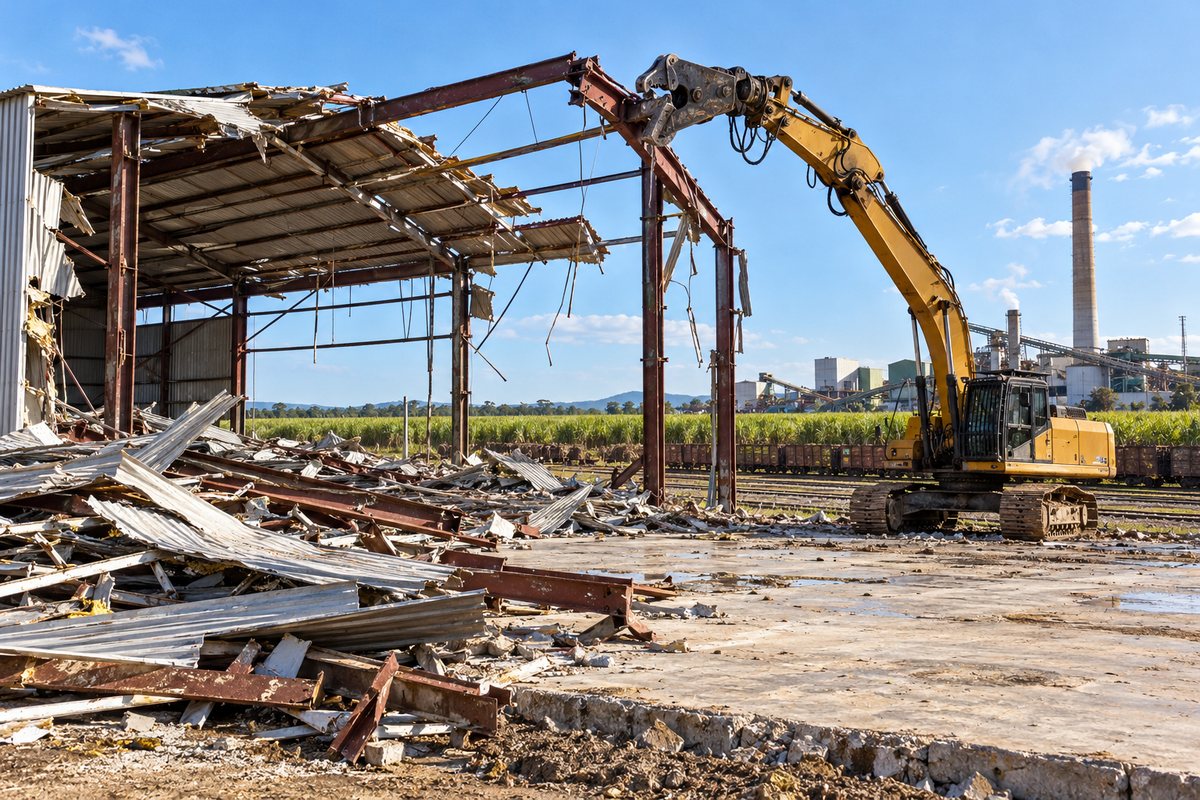
- Steel portal frame sheds, warehouses and workshops on industrial land
- Farm buildings: machinery sheds, packing sheds, cane barracks and old sheds along the cane rail lines
- Service stations and car yards, with the environmental work scoped separately
- Concrete-framed buildings, including those with suspended floors or tensioned slabs
Residential work is on house demolition; a small shed on a business premises is closer to shed and garage demolition. Everything here assumes a commercial or industrial structure.
The WHSQ licence and what makes a job licensable
Every commercial demolition job in Queensland is done by a business holding a demolition work licence from Workplace Health and Safety Queensland under the WHS Regulation 2011. The domestic exception for a carport pulled down by hand does not apply to a commercial building. On the WHSQ demolition licence page three features make any demolition licensable regardless of building type: pre-tensioned or post-tensioned concrete, load-shifting machinery such as an excavator, loader, skid steer or crane, and explosives or induced collapse. A commercial job involves at least one of these almost by definition, and it is licensable anyway because the structure is not a house or an ancillary domestic building.
The licence is issued to the business, runs for two years, and brings obligations: a nominated supervisor on site, trained workers, and the SWMS described below. WHSQ publishes a list of licensed demolition contractors. The licence does not cover asbestos; that is a separate Class A or Class B licence, and on an industrial building both are usually needed. QBCC does not regulate the demolition itself, though the building work that follows on the cleared site is QBCC-licensed. The split is explained under permits and licences.
Form 65 notification and safe work method statements
WHSQ must be told before certain demolition starts. Under the demolition notification rules, a Form 65 goes to WHSQ at least five days before work begins where a load-bearing part of the structure is 6 m or more high, where load-shifting machinery will be used on a suspended floor, or where explosives are to be used. A two-storey shop, a warehouse with a mezzanine and a tall portal shed may fall within that; the contractor measures. The contractor lodges the notice, but the five days need to be in the program.
Demolition is construction work under Chapter 6 of the WHS Regulation, and demolishing a load-bearing element is high risk construction work, so a written safe work method statement is required before it starts. The SWMS covers the sequence, exclusion zones, the method for each part of the structure, services isolation, dust and noise, and what happens if something unplanned moves. A structural collapse during demolition is a notifiable dangerous incident. On anything with a tensioned slab an engineer's release sequence is not optional. The WHSQ demolition hazard page describes the supervision and training duties.
| Trigger | What the regulation requires | Who does it |
|---|---|---|
| Any commercial building, any method | WHSQ demolition work licence | The contractor's business |
| Load-bearing part 6 m or more high | Form 65 to WHSQ at least 5 days before | Contractor |
| Machinery on a suspended floor | Form 65 to WHSQ at least 5 days before | Contractor |
| Pre or post-tensioned concrete | Licensed contractor, engineered release sequence | Contractor and engineer |
| Demolishing load-bearing elements | Safe work method statement before work starts | Contractor |
| Licensed asbestos removal | Form 65 at least 5 days before, control plan, clearance | Licensed removalist |
Asbestos in commercial and industrial buildings
Asbestos is the biggest variable in a commercial demolition budget. WHSQ presumes it in anything built before 31 December 1989, and in an industrial building the likely places are many: fibro cladding and partitions, asbestos cement roofing, vinyl floor tiles, switchboard backing boards, lagging on steam pipes and boilers, gaskets in plant and fire doors. In a mill-era building the pipe lagging and boiler insulation can be friable, which moves the removal from Class B to Class A. Plant is a separate question from the building: ask the removalist about asbestos in plant and gaskets as well as the building.
If the workplace has an asbestos register, it is the starting point for the demolition survey, not the end of it: registers cover what a tenant could disturb, not what is inside walls and under floors. The removalist's control plan is prepared from the survey, licensed removal is notified to WHSQ on a Form 65 at least five days ahead under the asbestos notification rules, and the work is cleared afterwards: Class B by an independent competent person, Class A by a licensed asbestos assessor. Commercial transport needs waste tracking regardless of quantity, and the only facility in the region that accepts asbestos is the Bundaberg Waste Facility at 46 University Drive, at $208 a tonne (minimum $45) from 1 July 2026, with prior notice on loads over 10 cubic metres. See asbestos rules.
Waste, the levy and scrap
Commercial demolition produces waste by the hundred tonnes. Council's mixed construction and demolition rate from 1 July 2026 is $359 a tonne, with clean concrete at $240 a tonne at the Bundaberg facility. The state levy ($135 a tonne in 2026-27 under the current levy rates, rising $10 a year) applies to landfill in the Bundaberg region; ask council how it is reflected in the gate fee. On a commercial load the levy rewards sorting: concrete kept clean, steel to the scrap yard, hardwood salvaged, and only true mixed waste to landfill at the full rate.
Steel is the saving. A portal frame shed is mostly structural steel, purlins and sheeting, all of it cut with a shear, loaded and sold as scrap, and the value is credited against the demolition cost on most quotes; ask for it to be shown separately. Loads over 3 cubic metres and vehicles over 8 tonnes go to Bundaberg rather than Qunaba. Full details in what happens to the waste.
Traffic management, road reserve permits and services
A shop in Bourbong Street or a workshop on a busy road in Kepnock cannot be demolished without affecting the street. Hoardings, a crane or truck in the parking lane, a skip on the footpath and any lane closure all involve council's road reserve, and under the Local Law the work needs approval through the works in the road reserve process. In 2026-27 a use of road reserve permit for depositing materials, construction or traffic management is $550 with renewal at $183, and a technical assessment for works in the road reserve is $222. Council engineering services are on 1300 883 699. The traffic management plan itself is prepared by a qualified traffic management company.
Services are disconnected before anything comes down. Electricity is removed through the retailer with Ergon, who confirm in writing before demolition starts, with 20 business days for urban removals and the 2026-27 fees of $485.15 for service line removal and $107.33 for the meter on standard connections. Water and sewer are disconnected only by council staff, on the Notice to Service Provider form. Reticulated gas is disconnected through Australian Gas Networks, and NBN quotes lead-in removal case by case.
Approvals, overlays and the cane rail lines
Demolishing a commercial building is building work under the Building Act 1975 and needs a building approval from a QBCC-licensed private certifier; council has not certified since 7 September 2015. The certifier confirms the current conditions and the Building Act timeframes. Planning is layered on top. A development application is needed to demolish a Victorian, Federation or Interwar building in a mapped neighbourhood character area, which covers the Bundaberg and Childers heritage town centres, and for any of the 79 local heritage places, where demolition is generally not supported and the council fee is $1,770 in 2026-27. The council heritage page is the place to check an address, and heritage and character demolition explains the process.
The other overlay that matters on industrial and farm land is Infrastructure, which under the 2015 planning scheme overlays includes the cane railways. Where a shed sits beside a cane rail line, and some of the region's do, demolition next to it means a working corridor during the crushing season and an overlay that can make the work assessable. The contractor's plan treats the line as a live hazard: an exclusion distance, machinery slewing clear of the corridor, and the mill's rail operations contacted before work starts. Flood hazard also matters in North Bundaberg and on the river flats, where the 2013 Burnett River flood reached 9.53 m; code assessment triggered only by the flood or heritage overlays carries no council fee.
To get started, send the address, building type and any drawings or asbestos register through the quote form. A licensed contractor inspects, arranges the asbestos survey and engineering, and prices the job with the levy, the scrap credit and the permits shown. Demolition then runs in sequence: asbestos, soft strip, structure, slabs and footings, then the pad graded and the waste dockets handed over. The checklist lists the owner's side of that.
What this cannot do
We arrange licensed demolition and asbestos contractors for commercial and industrial sites; we do not demolish buildings, prepare engineering, traffic management plans or asbestos surveys ourselves. We are not certifiers, planners or lawyers and cannot say whether a particular building needs a development application, what the planning scheme overlays mean for a specific lot or how the cane rail operator will respond to a request. Figures on this page are council, state levy and Ergon amounts for 2026-27 and change each year. Contaminated land, underground fuel tanks and environmental authorities are outside the scope of a demolition quote and need their own specialists. Nothing here is a quote, and nothing here replaces the WHSQ regulation and codes of practice the contractor works under.
Check the current rules before you rely on this
This page describes how commercial and industrial buildings are demolished in the Bundaberg region, including WHSQ licensing and notification, asbestos, the waste levy, road reserve permits and the cane rail overlay. It describes the rules in general terms as they stood in October 2026. Standards, forms, thresholds and fines change.
The authoritative sources are Workplace Health and Safety Queensland, demolition work licence, Workplace Health and Safety Queensland, demolition notifications, Workplace Health and Safety Queensland, asbestos notifications, Waste Reduction and Recycling (Variation of Waste Levy) Amendment Regulation 2026, ABLIS, approval for works on public areas and roads, Bundaberg Regional Council and Bundaberg Regional Council planning scheme overlays factsheet. Where anything here differs from those sources, they are right and we are not.
We are not building certifiers, engineers, planners or lawyers. For what applies to your property, ask a licensed building certifier or ring Bundaberg Regional Council on 1300 883 699.
Accurate at the time of writing, October 2026. Always check the source before relying on it.