The overlay that decides whether planning gets involved
Most demolition in the Bundaberg region only needs a building approval from a private certifier. The exception is property mapped under the Heritage and neighbourhood character overlay in the Bundaberg Regional Council Planning Scheme 2015. The overlay is one of 12 in the scheme, and the one that most often turns a simple demolition into a development application. Council's planning scheme overlays fact sheet lists the full set; the others are discussed further down because several can touch a demolition without stopping it.
The overlay has two components. Neighbourhood character areas are mapped precincts, typically the older timber and tin suburbs near the city centre and the heritage town centres of Bundaberg and Childers. Local heritage places are individual properties listed in the scheme. A house can be in a character area without being a heritage place, and the reverse. The first step is to check council's mapping for your lot, which the duty planner on 1300 883 699 or development@bundaberg.qld.gov.au can confirm. Council's heritage properties page is the starting point online.
Character areas and the Victorian, Federation and Interwar test
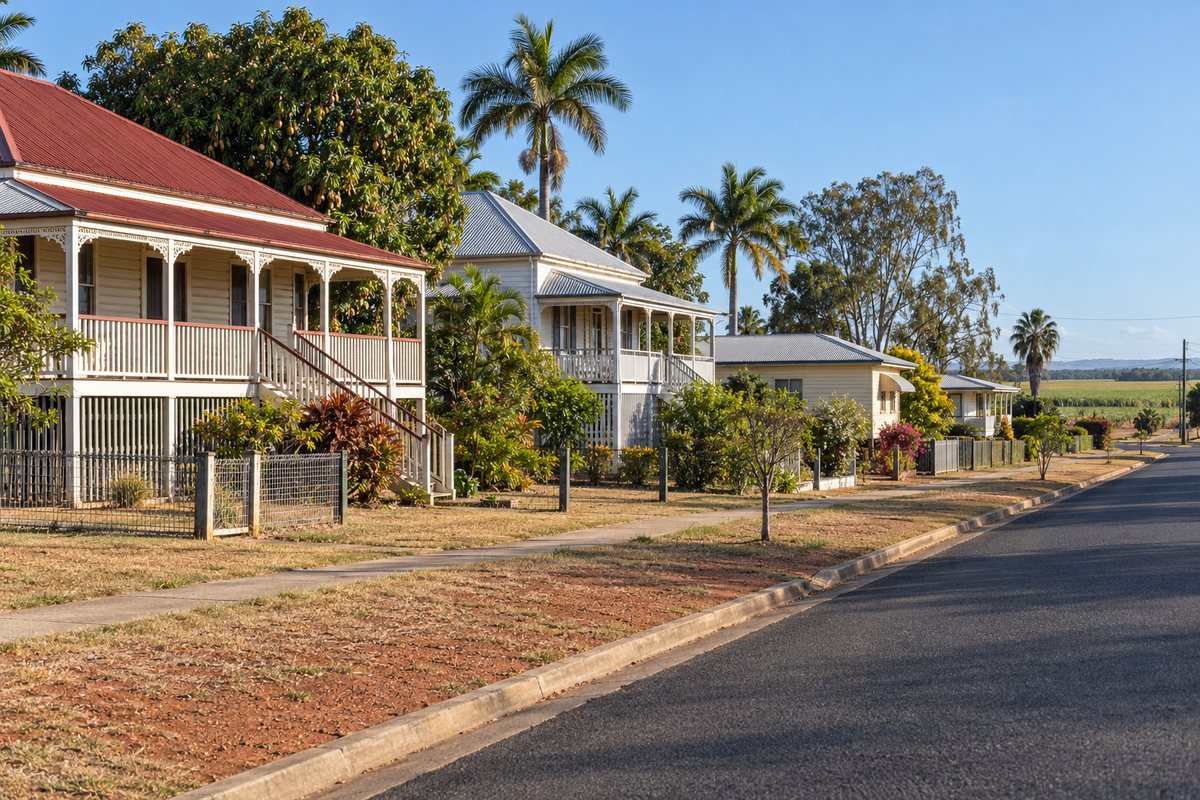
Inside a mapped neighbourhood character area, a development application is required to demolish, relocate or remove a Victorian, Federation or Interwar building. The test is the architectural era of the building, not a calendar year. That matters because people who have dealt with Brisbane assume the pre-1946 rule applies everywhere in Queensland. It does not; Brisbane's rule is a Brisbane City Plan provision. In Bundaberg the question is whether the building reads as a Victorian, Federation or Interwar house, which in practice means the high-set timber Queenslanders and earlier cottages of Bundaberg South, Bundaberg East and the streets near Bourbong Street, where the town grew from 1869 and the city was proclaimed in 1913. Bundaberg East has been settled since 1882 around the Millaquin mill and Bundaberg South had schools from 1875, so those suburbs carry a lot of character stock.
The flip side is that a post-war fibro house in the same street is usually outside the test, even if the street is mapped. Walkervale is the obvious example, a post-war suburb with its church from 1949, school from 1955 and pool from 1961, and Avenell Heights was only named in 1967. A 1960s fibro cottage on a character-area street is not Victorian, Federation or Interwar, so the planner would normally treat its demolition as outside the trigger, though the certifier still confirms that and any other overlay still applies. The planner decides, and the eras can be argued at the margins, particularly for Interwar houses extended later.
Relocation counts the same as demolition. Lifting a Federation Queenslander onto a low-loader and taking it out of a character area needs the same development application as knocking it down, which is one reason the demolish or remove guide treats the planning step as common to both.
The 79 local heritage places
Local heritage places are listed individually. There are 79 of them: 69 identified in a 2014 heritage study and a further 10 in a 2016 study, brought into the scheme by an amendment council adopted on 21 January 2020. Demolition of a local heritage place needs a development application, and the application is assessed against the overlay code. Council's heritage places and neighbourhood character fact sheet is blunt about the likely outcome: demolition of a local heritage place is generally not supported, and would only be considered where there is no prudent or feasible alternative. In practice that means an owner needs to show that the building cannot reasonably be retained, repaired or adapted, usually with structural evidence, before council will contemplate approving its loss.
Council issues Heritage Exemption Certificates for minor work on local heritage places, but the certificate scheme excludes demolition. So there is no shortcut: minor maintenance can be exempted, demolition cannot. Partial demolition, such as removing a rear lean-to or an unsympathetic 1970s extension, is often the realistic path, and a partial demolition that removes later additions and keeps the significant fabric is the kind of application a planner can support.
To soften the cost of keeping these places, council runs a heritage grants program: $100,000 in 2025-26, with up to $10,000 per project. That is worth knowing before you conclude that the only answer to a tired heritage building is the excavator.
State heritage: the 54 register places and DETSI
Above the local list sits the Queensland Heritage Register, with 54 places in the region. These are not council's to approve; demolition or substantial work on a state-registered place needs approval from the Department of the Environment, Tourism, Science and Innovation (DETSI), reachable on 13 74 68 according to council's heritage page. Council's assessment still applies in parallel if the place is also locally listed or in a character area, but the state decision controls demolition. Demolition of a state heritage place in Bundaberg is rare and this page does not pretend to guide it; if you own one, start with DETSI and a heritage consultant.
| Situation | Who assesses | Demolition outlook | Council fee 2026-27 |
|---|---|---|---|
| Victorian, Federation or Interwar building in a character area | Council, code assessment against the overlay | Possible, assessed on merit | No charge if triggered only by the overlay |
| Post-war building in a character area | Certifier, with overlay checked | Usually outside the demolition trigger; planner confirms | Not applicable |
| Local heritage place (79 listed) | Council, development application | Generally not supported unless no prudent or feasible alternative | $1,770 for building works involving demolition or removal |
| Queensland Heritage Register place (54 in region) | DETSI, state approval | Rare | Ask DETSI; council fee may also apply |
| Flood hazard overlay only | Council, code assessment | Certifier confirms what the overlay means for the demolition; rebuild conditions apply | No charge for the overlay trigger |
Timeframes and fees
Council may request further information within 10 business days of the application being properly made, and then decides within 20 business days once it has what it needs. Those figures come from council's heritage page and describe the assessment period, not the whole timeline: preparing the application, obtaining a heritage impact statement or structural report, and answering an information request all add time. A realistic allowance for a character-area demolition application is a couple of months from first contact to decision, and longer for a local heritage place.
Fees are more favourable than owners expect. Under council's 2026-27 fees and charges, code assessment triggered only by the Heritage and Neighbourhood Character Overlay or the Flood Hazard Overlay carries no charge. Building works involving the demolition or removal of a local heritage place are $1,770. Other building works made assessable under the scheme are also $1,770, and building works for a dwelling house are $710. Fees change each July, so ask council for the current figure. The certifier's own fee is separate and set by the certifier.
The other overlays that can touch a demolition
The heritage overlay is the one that can stop a demolition. The others usually do not, but they shape the conditions and sometimes trigger a code assessment of their own. The Flood hazard overlay covers the Burnett River floodplain, localised flooding and coastal storm tide, and after the 2013 flood peaked at a record 9.53 metres and inundated more than 4,000 homes, a good deal of North Bundaberg and the river flats is mapped. Where the flood overlay triggers code assessment, council charges no fee for that trigger; the certifier confirms what the overlay means for the demolition and the rebuild, and anything rebuilt afterwards will carry flood conditions, so owners on the flats should read the North Bundaberg page.
The Coastal protection overlay can apply along the coast, where erosion and storm tide mapping can affect what goes back on the block; check the mapping for your lot. The Acid sulfate soils overlay has two areas: Area 1 at or below 5 metres AHD and Area 2 from 5 to 20 metres, so low-lying land at or below 5 m AHD, which can include parts of the coast near river and creek mouths, may be in Area 1; check the mapping. Demolition rarely disturbs enough soil to matter, but removing a pool, deep footings or an old septic tank on low ground near the river or the coast can, and the contractor's management of excavated material may be conditioned. The Biodiversity overlay brings council's vegetation management code into play if the block holds remnant vegetation; a permit may also be needed under state law to clear protected plants, though clearing for an urban purpose on freehold land in an urban area is exempt under the Planning Regulation. Council's native plants page is the reference. The Infrastructure overlay includes the cane railways, which still run through parts of the region, and a demolition next to a tramline needs the operator's clearance arrangements in the management plan.
The remaining overlays, Bushfire hazard, Steep land, Agricultural land, Extractive resources, Water resource catchments and Airport, rarely affect a suburban demolition but can apply to rural blocks around Gin Gin and Childers. The certifier identifies which overlays apply when the application is lodged, and that is the moment to ask what each means for the site.
What to do if your house is in the overlay
First, confirm the mapping with council's duty planner rather than guessing from the age of the house. Second, work out which component applies: character area, local heritage place, state register, or more than one. Third, decide what you actually need. Many owners want more space or a modern house, and a planner will often support demolishing a later rear addition and building behind a retained front, which keeps the streetscape and avoids the hardest argument. Fourth, if full demolition is the only option, assemble the evidence before lodging: a structural engineer's report, costings for repair against replacement, photographs, and for a heritage place a heritage impact assessment. Fifth, lodge the development application and let it run before engaging the certifier, because the certifier will normally want the planning approval in hand first.
A licensed demolition contractor is still needed at the end, with a WHSQ demolition work licence and, for a pre-1990 house, an asbestos removal licence. The permits and licences page covers that side, and house demolition describes the work on a character-area block, where hand stripping of salvageable timber is common.
What this page cannot do
This page cannot tell you whether your lot is inside a character area or on the local heritage list; only council's overlay mapping and the duty planner can confirm that, and the mapping is amended from time to time. It cannot predict how a planner will assess a particular building's era or condition, and it cannot describe the state heritage process beyond pointing you to DETSI. The fees and timeframes are council's 2026-27 figures and published assessment periods and will change. Nothing here is planning advice; a town planner, heritage consultant or the council's own officers decide what applies to your property, and a certifier confirms the building approval conditions.
Check the current rules before you rely on this
This page describes how the heritage and neighbourhood character overlay and the other planning overlays affect demolition in the Bundaberg region. It describes the rules in general terms as they stood in October 2026. Standards, forms, thresholds and fines change.
The authoritative sources are Bundaberg Regional Council, heritage properties and neighbourhood character, Bundaberg Regional Council heritage places and neighbourhood character factsheet, Bundaberg Regional Council planning scheme overlays factsheet, Bundaberg Regional Council Fees and Charges 2026-27 and Building Act 1975 (Queensland). Where anything here differs from those sources, they are right and we are not.
We are not building certifiers, engineers, planners or lawyers. For what applies to your property, ask a licensed building certifier or ring Bundaberg Regional Council on 1300 883 699.
Accurate at the time of writing, October 2026. Always check the source before relying on it.