The sheds and garages we take down
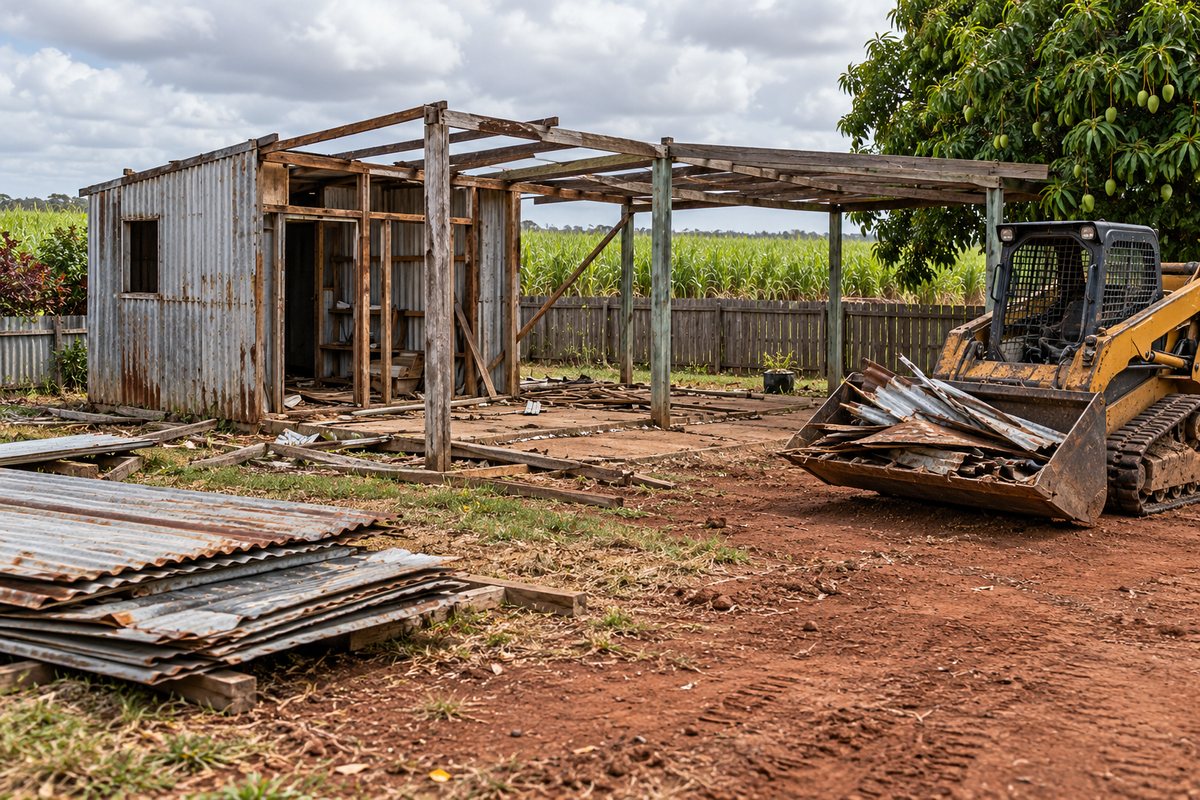
Most blocks in Bundaberg have at least one outbuilding that has outlived its use. On the older streets of Bundaberg South and East it is generally a timber garage with a skillion roof, built when cars were narrower. In Walkervale and Avenell Heights it is more often a post-war iron shed on a slab, broadly speaking, a steel carport bolted to the house, or a lean-to added for the mower. Out towards Gin Gin and Childers the job is bigger: open-sided farm sheds, machinery sheds and cane barracks on timber posts with patched iron walls.
The work itself is simple compared with a house. Roof sheeting comes off, then wall cladding, then the frame is dropped or cut down and sorted into iron, timber and rubbish. What takes the time is the preparation: finding out whether the walls or roof contain asbestos, deciding whether the slab stays, and checking what the certifier and the council expect. For the main house, see house demolition; for pulling out part of a building, see strip-out and partial demolition.
- Corrugated iron and Colorbond sheds, on a slab or on dirt
- Timber-framed garages with fibro, weatherboard or iron walls
- Steel and timber carports, attached and freestanding
- Lean-tos, awnings and skillion additions on the back of the house
- Farm sheds, machinery sheds, hay sheds and old cane barracks
- Garden sheds, aviaries, chook pens and dog runs that are too far gone to sell
Does a shed need a licensed demolition contractor?
Demolition contractors in Queensland are licensed by Workplace Health and Safety Queensland under the WHS Regulation 2011, not by QBCC. The licence rule has a specific exception that matters for sheds. On the WHSQ demolition licence page, a demolition work licence is not required where the structure is a domestic house, or an ancillary structure such as a carport or garage, and the work involves none of three things: pre-tensioned or post-tensioned concrete, load-shifting machinery, or explosives and induced collapse.
In practice that means a garden shed or a timber garage pulled apart by hand, with ladders, bars and a trailer, can be done without a demolition licence. The moment an excavator, skid steer or loader is used to push the frame over or load the rubble, the job involves load-shifting machinery and the exception no longer applies. Most contractors use a skid steer on anything bigger than a garden shed, so most shed jobs we arrange are done by a business holding the WHSQ licence anyway. The Business Queensland page confirms the licence is issued to the business and runs for two years.
A farm shed is not always an ancillary structure to a house. A large machinery shed on a rural block, or a shed with a mezzanine, is treated more like a commercial structure, and if a load-bearing part of it is 6 m or more high the contractor must lodge a Form 65 demolition notification with WHSQ at least five days before starting. For a fuller picture of who licenses what, read permits and licences.
Asbestos in old shed walls and roofing
This is the part most people underestimate. A shed built before 31 December 1989 is presumed to contain asbestos until it is tested, and sheds were exactly the kind of building where the cheapest sheet went on the wall. Flat fibro on garage walls, corrugated asbestos cement roofing (grey, slightly chalky, easy to mistake for iron from a distance), fibro lining inside a workshop, and the compressed sheet floor of an outside toilet attached to a garage are all common in Bundaberg. The roofing is the worst of it, because weathered asbestos cement roofs shed fibres and are brittle to walk on.
The licensing follows the amount. Under the WHSQ asbestos licence rules, more than 10 square metres of bonded (non-friable) asbestos needs a Class B asbestos removal licence; any friable asbestos needs Class A. A single garage wall can be more than 10 square metres, so a fibro garage is usually a licensed job. Under 10 square metres no licence is needed, but the How to Safely Remove Asbestos Code of Practice still applies and the sheets still have to be wet down, taken off whole, wrapped in two layers of 200 micron plastic, labelled and taken to a licensed facility. Licensed removal needs a Form 65 notification to WHSQ at least five days before it starts, a removal control plan, and a clearance certificate afterwards.
In this region asbestos is only accepted at the Bundaberg Waste Facility at 46 University Drive, at $208 a tonne (minimum $45) from 1 July 2026, wrapped, and with prior notice for loads over 10 cubic metres. It cannot go to Qunaba or the rural tips, and it must never go in a skip with the rest of the shed. We arrange the asbestos removal as a separate first stage; see asbestos removal before demolition and the asbestos rules page.
Leaving the slab or lifting it
A shed on a concrete slab leaves you with a choice. Leaving the slab is cheaper and gives you a hard stand for a caravan or trailer. Lifting it costs more because the concrete has to be broken, loaded and carted, but it is the right call if you are going to build, landscape or sell, because a bare slab with cut-off bolts in it is not something the next owner wants. Where a new shed is going on the same spot, the certifier for the new building decides whether the old slab can stay; an old slab with no edge beam and no record of its thickness usually cannot be relied on.
Clean concrete, free of soil, timber and mesh, goes to the Bundaberg Waste Facility at $240 a tonne (minimum $45) from 1 July 2026, against $359 a tonne for mixed construction and demolition waste, so the contractor pulls the mesh out and keeps the concrete separate. Small slabs are broken with a hammer on the skid steer; a thicker slab with an edge beam needs a bigger machine. Details are on concrete and driveway removal.
| Tip fee from 1 July 2026 | Rate | Where |
|---|---|---|
| Construction and demolition waste | $359 a tonne, min $45 | Bundaberg; Qunaba up to 3 m3 |
| Clean concrete | $240 a tonne, min $45 | Bundaberg Waste Facility only |
| Asbestos, wrapped | $208 a tonne, min $45 | Bundaberg Waste Facility only |
| Green waste | $160 a tonne, min $35 | Council facilities |
| Clean fill under 100 mm | Free | Council facilities |
Iron, steel and timber: what gets recycled
Sheds are mostly metal, and metal is the one part of a demolition that has a value rather than a cost. Corrugated iron, steel purlins and columns, Colorbond sheeting, roller doors and steel carport frames are stripped out, kept separate from the rubbish and sent to a scrap metal yard rather than the tip. The contractor usually keeps the scrap value, which is one reason a steel shed often costs less to remove than a timber one of the same size. Ask when you get a quote whether the scrap is being credited.
Hardwood framing from an old timber garage is worth saving if it is sound and free of paint and borer; it has a second life as fence rails or garden edging. Treated pine, chipboard, painted softwood and anything with fibro nailed to it goes in the skip as mixed waste at $359 a tonne, and green waste from vines over the shed goes separately at $160 a tonne. The state waste levy, $135 a tonne in 2026-27 and rising $10 a year, sits behind those fees, so the less that goes in the mixed skip the better. More in what happens to the waste.
What approval the certifier may want
Demolishing a building is building work under the Building Act 1975, and sheds and garages are buildings. Whether a particular shed needs a formal building approval before it comes down depends on its size, class and location, and that is a decision for a QBCC-licensed private building certifier, not for us; Bundaberg Regional Council has not issued building approvals since 7 September 2015. Small freestanding sheds may fall into a category that does not need a separate approval, but we do not promise that for any shed, and a garage attached to the house, or a shed being replaced by a larger one, is usually dealt with as part of the approval for the new work. The certifier confirms the current conditions and the Building Act timeframes.
Planning is a separate question. In a mapped neighbourhood character area under the Bundaberg Regional Council Planning Scheme 2015, a development application is needed to demolish a Victorian, Federation or Interwar building, and an early timber garage or stable can be caught by that in the older parts of Bundaberg and Childers. On a local heritage place, demolition needs an application, and the council heritage page sets out how to check. Code assessment triggered only by the heritage overlay has no council fee. If a skip or truck will sit on the footpath or road, a road reserve use permit costs $550 in 2026-27. Our checklist walks through this in order.
How a shed job runs
Once you send photos and a rough size through the quote form, a contractor looks at the shed, usually in person. They check for asbestos, note what is stored inside (you need to empty it, including chemicals and old paint tins), and look at power. A shed on a sub-circuit from the house can be isolated by an electrician; a shed with its own meter needs a connection removal through your retailer, and Ergon's urban removals take up to 20 business days. On demolition day the roof comes off, walls and frame follow, the slab is broken if that is the plan, and the ground is raked level. Most domestic sheds are gone in a day; a farm shed with asbestos runs in stages.
What this cannot do
We arrange licensed demolition and asbestos contractors; we do not demolish sheds ourselves, we are not building certifiers and we cannot tell you whether your particular shed needs a building approval or a development application. Those decisions sit with a QBCC-licensed private certifier and, for the planning overlays, with Bundaberg Regional Council. We cannot test for asbestos from photographs: presuming asbestos in a pre-1990 shed is the safe default, but only a sample tells you for certain. We do not buy scrap metal, set tip fees or move power and gas services. Fees quoted here are the council and Ergon figures for 2026-27 and change each July, so confirm them before you budget.
Check the current rules before you rely on this
This page describes how sheds, garages, carports and farm sheds are demolished in the Bundaberg region and which licences, asbestos rules and approvals usually apply. It describes the rules in general terms as they stood in October 2026. Standards, forms, thresholds and fines change.
The authoritative sources are Workplace Health and Safety Queensland, demolition work licence, Workplace Health and Safety Queensland, asbestos removal licences, Building Act 1975 (Queensland), Bundaberg Regional Council, heritage properties and neighbourhood character and Bundaberg Regional Council waste disposal fees 2026-27. Where anything here differs from those sources, they are right and we are not.
We are not building certifiers, engineers, planners or lawyers. For what applies to your property, ask a licensed building certifier or ring Bundaberg Regional Council on 1300 883 699.
Accurate at the time of writing, October 2026. Always check the source before relying on it.