When only part of the house is coming out
A lot of demolition work in the Bundaberg region is not a whole house. It is a kitchen stripped back to the frame for a renovation, a bathroom gutted, a rotten verandah or a 1970s sleep-out pulled off a Queenslander, a wall taken out to open up a living room, or an old extension removed so a better one can go on. The work is smaller but the rules are not simpler, because the same three questions apply: does the certifier need to approve it, is there asbestos in what is being removed, and is any of it load-bearing. A good strip-out contractor answers all three before quoting, and that is the difference between a partial demolition and a renovation that stalls while someone sorts out the paperwork.
Partial work also has to be done around a house that is staying. Dust, vibration, weather protection and the structure that remains all matter in a way they do not on a full demolition. Pulling a lean-to off the back of a high-set home leaves an open wall and a floor edge that need temporary protection; stripping a bathroom means protecting the hardwood floor in the hallway; removing a wall means propping before cutting. Builders in the region often sub this stage out precisely because it needs its own licence and its own sequence.
Kitchen and bathroom strip-outs
A kitchen strip-out takes out cabinetry, benchtops, appliances, splashbacks, the sink and tapware, floor coverings and usually the wall and ceiling linings back to the studs and joists. A bathroom strip-out takes out the bath, shower, vanity, toilet, tiles, the screed or sheet under the tiles, and the linings. In a post-war house in Walkervale, Avoca or Kepnock the wet area linings and the sheet under the tiles are very often fibre cement, and a single bathroom's walls can exceed the 10 square metre threshold on their own. That makes the strip-out licensed Class B asbestos removal, notified to WHSQ five days ahead, with a clearance certificate at the end. The asbestos removal page explains the stages; the point here is that a bathroom in a 1960s house is rarely a job for a labourer with a crowbar.
Plumbing and electrical are capped off by licensed trades before the strip-out, not by the demolition crew. The contractor needs to know which services are staying live elsewhere in the house, which is a different situation from a full demolition where everything is abolished. Floor coverings in older kitchens deserve a look too: vinyl tiles and the black adhesive under them are on the list of materials that commonly contain asbestos, and lifting them is part of the licensed scope if they test positive.
Removing an extension, verandah or sleep-out
Nearly every old Queenslander in the region has gained something since it was built: a verandah enclosed into bedrooms, a sleep-out tacked on the side, a fibro lean-to kitchen at the back, a laundry built in under the house, or a 1980s extension on a slab. Many of these were poorly built, let water into the original frame, or simply are not worth keeping when the house is being brought back. Removing them is partial demolition. The contractor separates the addition from the original structure at the junction, takes care of any roof that is shared, removes the addition's footings or slab, and makes the original wall weatherproof again or leaves it ready for the builder.
Two things complicate it locally. First, the addition is often the part of the house that contains the asbestos, even when the original is all hardwood and weatherboard, because the additions date from the fibro era. Second, additions on the river flats were sometimes built low on the heavy Burnett clays and have moved differently from the stumped original, which means the junction can be carrying load it was never meant to. A contractor who props the shared roof before cutting rather than after is one who has done this before. On a high-set house the removal of a verandah can also leave an edge more than six metres above the ground at the ridge, which brings the WHSQ demolition notification into play if the element being removed is load-bearing.
Taking out a wall: load-bearing or not
This is where the WHS Regulation draws its line. Removing part of a load-bearing structure is demolition work under the WHS Regulation, with a safe work method statement; the WHSQ licence is required once machinery is used or the building is not a domestic house. Removing non-load-bearing plasterboard or lining is not demolition. There is one qualification that matters for renovations: if a replacement load-bearing element, such as a beam and posts, goes in before the wall is removed, the work is not classed as demolition. That is the normal way a builder opens up a living room, and it is why the sequence is beam first, wall second. The definitions are on the WHSQ demolition licence page and the hazard guidance on the WHSQ demolition hazards page.
Which walls carry load is not always obvious in a Queenslander. The external walls do, and so do the internal walls that line up with bearers and carry the ceiling joists or a roof strut, but older houses have been altered so many times that the original load path can be hard to read. A structural engineer or the certifier decides; the demolition contractor does not guess. Where there is doubt the wall is treated as load-bearing, propped and replaced with a beam in the proper order.
| Work | Demolition under the WHS Regulation? | Usual approach |
|---|---|---|
| Remove plasterboard or VJ lining | No | Strip-out, asbestos check first |
| Remove a non-load-bearing partition | No | Strip-out, services capped |
| Remove a load-bearing wall | Yes | SWMS, prop before cutting; WHSQ licence if machinery is used or it is not a domestic house |
| Install beam, then remove wall | Not demolition | Builder's sequence, engineer's design |
| Remove a verandah, sleep-out or extension | Yes if load-bearing | WHSQ licence, Form 65 if 6 m or more |
Salvaging the hardwood
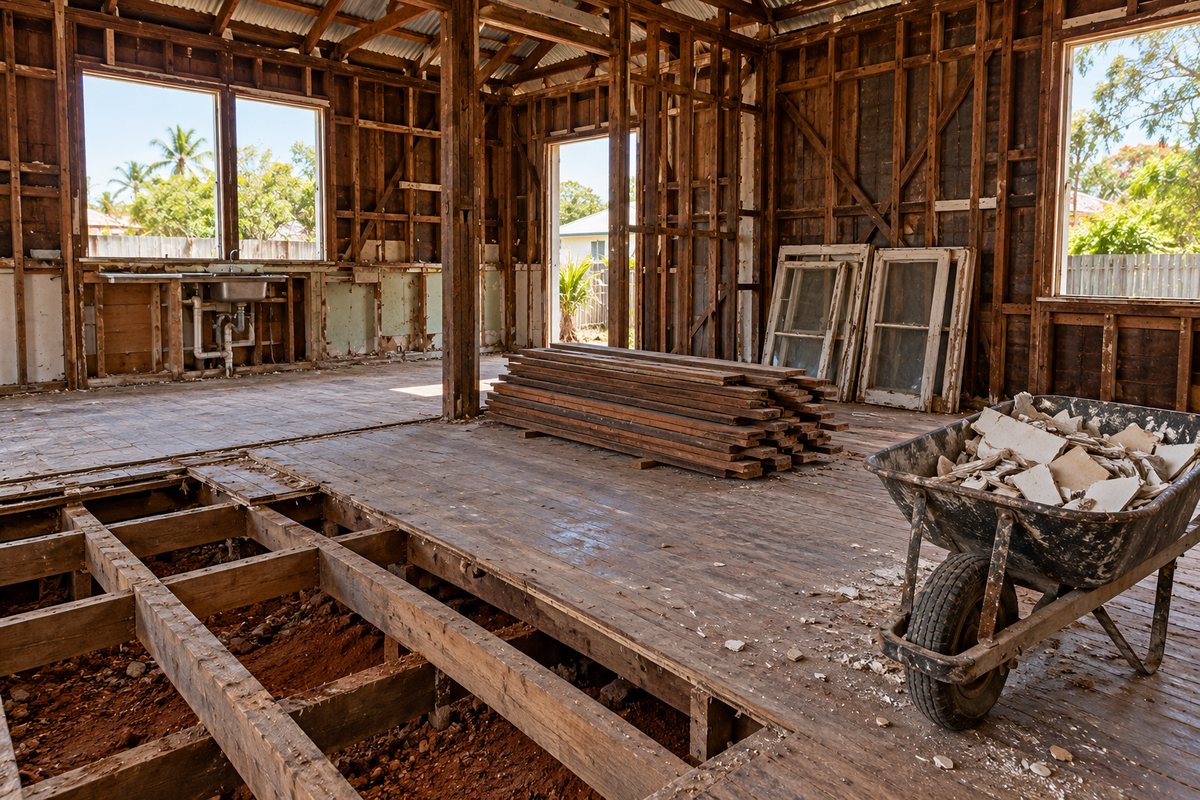
The one thing a Bundaberg strip-out produces that is worth real money is hardwood. Houses here were framed and floored in dense Queensland hardwoods that are no longer available new at any sensible price, and a careful strip-out lifts floorboards, joists, studs, verandah posts and French doors intact rather than splintering them with a machine. Boards are de-nailed and stacked, as in the photo above, and either go back into the renovation, get sold, or are credited against the job. Iron roofing sheets, if they are not too rusted, are worth keeping too. Salvage takes longer than smashing, so tell the contractor what you want kept before they quote, and expect the price to reflect the extra hours and the offset. What cannot be reused still has to be sorted: construction and demolition waste is $359 a tonne at the council facility from 1 July 2026, clean green waste is $160, and the Qunaba facility at Bargara takes loads up to three cubic metres, which suits a strip-out trailer. What happens to the waste has the full list.
What needs approval and what does not
This is the question most people ask first and it is the one with the least certain answer, because the certifier decides. The general position under the Building Act 1975 is that building work, which includes altering or demolishing a building or part of one, is assessable unless it falls within a class of accepted development, and the lists of what is accepted are detailed and change. Replacing linings and fit-out inside a house is usually not something a certifier needs to approve. Removing a structural wall, removing a roofed extension, changing the footprint of the house or doing anything to a verandah on a house in a mapped neighbourhood character area is usually something they do. Where the house is one of the region's 79 local heritage places, or a Victorian, Federation or Interwar building in a character area, even partial demolition of the street-facing fabric can need a development application to council first; see heritage and character rules. The council's own starting point is the Bundaberg building and planning approvals page.
The sensible order is to describe the work to a private building certifier before anyone picks up a tool, because the same phone call tells you whether an approval is needed and roughly what the certifier will charge. If an approval is required, the Building Act's time limits on demolition work apply: substantial start within two months, completion within a year, and the certifier confirms the current conditions. If the building work after the strip-out is worth more than $3,300, the builder doing it needs a QBCC licence; the strip-out itself sits under WHSQ. Our permits and licences page separates the two regimes.
Strip-outs are also where people are tempted to use an unlicensed mate with a trailer. For lining and fit-out that may be lawful, but the moment the work touches asbestos over 10 square metres or a load-bearing element it is licensed work, and the owner who arranged it carries the exposure if something goes wrong. Request a quote and describe the rooms, the age of the house and what you want kept; the contractor will come back with a scope that says which parts are strip-out, which are licensed removal and which need the certifier.
What this page cannot do
This page cannot tell you whether a particular wall in your house is load-bearing, or whether your renovation needs a building approval. The first is a question for a structural engineer or the certifier looking at the house, and the second is the certifier's decision under the Building Act and the planning scheme overlays for your lot. It cannot confirm that your bathroom or sleep-out is free of asbestos; a survey does that. It cannot give a price, since strip-out pricing depends on how much is to be salvaged, how much is licensed removal and how the house is built. Treat it as a map of the questions to ask, then let the certifier and the contractor answer them for your property.
Check the current rules before you rely on this
This page describes how interior strip-outs and partial demolition are scoped, licensed and approved in the Bundaberg region. It describes the rules in general terms as they stood in October 2026. Standards, forms, thresholds and fines change.
The authoritative sources are Workplace Health and Safety Queensland, demolition work licence, Workplace Health and Safety Queensland, demolition hazards and the WHS Regulation, Workplace Health and Safety Queensland, asbestos removal licences, Building Act 1975 (Queensland) and Bundaberg Regional Council, building and planning approvals. Where anything here differs from those sources, they are right and we are not.
We are not building certifiers, engineers, planners or lawyers. For what applies to your property, ask a licensed building certifier or ring Bundaberg Regional Council on 1300 883 699.
Accurate at the time of writing, October 2026. Always check the source before relying on it.