Why Bundaberg pools get removed
Backyard pools went into Bundaberg and Bargara yards from the 1970s onward, broadly, and a lot of them are now forty or fifty years old. Concrete shells crack and leak, fibreglass shells lift or craze, pumps and filters cost money to run, and a pool safety certificate is needed on sale or lease. For an older owner the pool is a chore; for a buyer it is a liability that needs a pool safety certificate on sale or lease. Removing it returns the yard, ends the running cost and takes the barrier obligations off the title. It is smaller work than a house, usually a day or two of machine time, but it has its own approval path and its own paperwork at the end, and skipping either one causes problems when the property is next sold.
This page covers the two types of pool found in the region, the two ways of removing them, the rule that a decommissioned pool must not hold more than 300 millimetres of water, why the barrier stays up until the certifier says otherwise, the engineer's compaction certificate, and the email to QBCC that takes the pool off the register.
Concrete pools and fibreglass pools
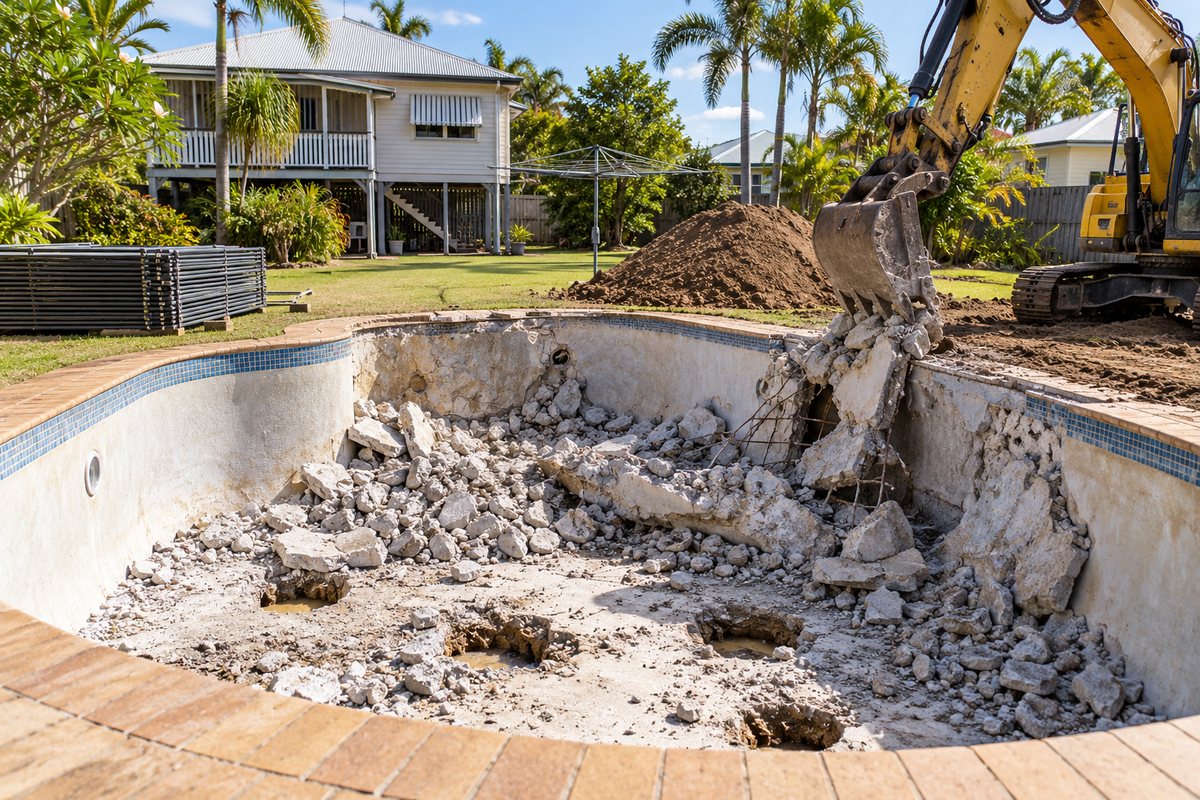
A concrete pool is a reinforced shell sprayed or poured in place, usually 150 to 250 millimetres thick with steel mesh through it, with a tiled or painted finish and a concrete or paved surround. Removing one means breaking the shell with a hammer attachment on an excavator, cutting and bending up the steel, and either hauling the rubble out or burying the broken pieces in the hole. The rubble is heavy; a modest concrete pool can produce many tonnes of it, and clean concrete is charged at $240 a tonne at the Bundaberg Waste Facility from 1 July 2026 against $359 a tonne for mixed construction and demolition waste, so keeping the concrete separate from the paving, the tiles and the fibreglass matters.
A fibreglass pool is a single moulded shell set in a sand or gravel bed with a concrete collar around the rim. It cannot be left in the ground in pieces the way concrete can, because fibreglass does not break down and does not compact. The shell is cut into sections with a saw and lifted out, the collar is broken up, and the hole is backfilled from the bed up. Fibreglass sections go to the tip as mixed waste. The job is lighter on the hammer and heavier on the saw, and the sand bed under the shell usually has to come out or be properly compacted because it was never placed to carry a load.
Partial fill or full removal
There are two ways to decommission a pool and the certifier's approval will say which one you are doing. A partial fill, sometimes called a partial demolition, leaves most of the shell in the ground. The top section of the walls is broken down to a set depth below finished ground level, holes are punched through the floor so the shell cannot hold water, the broken concrete is placed in the bottom, and the hole is filled and compacted in layers. It is cheaper, produces less waste, and is the usual choice when the area will become lawn or garden. The downside is that the shell stays on the title: a future buyer's solicitor will ask about it, nothing can be built over it without an engineer looking at it, and the drainage holes have to work for good.
A full removal takes out the entire shell, the surround, the plant and all the plumbing, and backfills the hole with engineered fill compacted in layers from the base up. It costs more and sends more to the tip, but it leaves a block that is simply a block, which a builder can put a slab, shed or extension on once the engineer has certified the fill. If there is any chance of building over the area later, full removal is the one to specify, because retrofitting footings through a buried shell is far more expensive than taking it out now.
| Question | Partial fill | Full removal |
|---|---|---|
| Shell left in ground | Yes, broken and holed | No |
| Waste to tip | Less, mostly surround and fittings | All of the shell and surround |
| Build over it later | Only with an engineer's advice | Yes, on the certified fill |
| Engineer's compaction certificate | Usually required by the certifier | Required |
| Disclosure at sale | Buried shell on the property | Pool removed, fill certified |
The 300 millimetre rule and the barrier
QBCC's position is that decommissioning a pool may require a building approval, and in Bundaberg that approval comes from a QBCC-licensed private building certifier, the same as any other demolition. The reason the approval matters is the barrier. A pool is a pool, with all its fencing obligations, until it has been decommissioned under an approval, and the fence must not come down until the certifier has issued the demolition approval. Pulling the fence off first to give the excavator access is the most common mistake owners make, and it leaves an open body of water in a yard with no barrier, which is dangerous and a breach of the pool safety rules. The excavator can usually reach over or a panel can be reinstated temporarily; the contractor plans the access around the fence, not the other way round.
The second rule is the 300 millimetre one. Once the pool is decommissioned it must not be capable of holding more than 300 millimetres of water. That is why a partial fill breaks holes through the floor and knocks the walls down below ground level rather than simply filling the shell, and why the fill is compacted and graded so it does not sink into a dish that ponds in a wet season. A shell that is merely filled with loose soil and sand can settle enough to hold water again, at which point it is a pool again in the eyes of the regulator. The QBCC guidance is on the QBCC pool decommissioning page; the Fraser Coast council fact sheet sets out the same practice for the next council south and is the clearest plain-language statement of the barrier rule.
Compaction and the engineer's certificate
Fill placed in a pool hole has to carry the lawn, the paving or the building that goes on top, and it has to stay put when the Bundaberg wet season arrives. The contractor places it in layers, each one compacted before the next goes in, and a geotechnical or structural engineer tests and certifies the compaction. The certificate is the document the certifier usually wants before finalising the approval, the document a future builder wants before pouring a slab, and the document a buyer's solicitor wants on sale. Without it the fill is just dirt in a hole.
Local ground matters here as much as it does for houses. On the Woongarra red volcanic loams between Bundaberg and the coast at Bargara, drainage is good and the holes punched through a shell actually drain. On the Burnett alluvial clays of the river flats the ground holds water, and a shell left in the ground can sit in a saturated clay that does not let the drainage holes work; a contractor there may recommend full removal or additional drainage, and the engineer should be told what the soil is. Parts of the coast also sit within the acid sulfate soils overlay, which covers ground at or below 5 metres AHD and a second area from 5 to 20 metres, and excavation in those areas can carry conditions from the certifier about how the spoil is handled.
Taking the pool off the QBCC register
Decommissioning a pool physically does not take it off the QBCC pool safety register. The pool stays on the QBCC register until the owner writes to poolsafety@qbcc.qld.gov.au; ask QBCC what evidence it wants. Until that is done the property still shows as having a pool. Keep the whole file together: approval, clearance of any asbestos found in old pool sheds or fencing, compaction certificate, tip receipts and the QBCC confirmation.
What it means when you sell
A property with a regulated pool needs a pool safety certificate before it is sold or leased, valid for two years for a non-shared pool and one year for a shared one, and the barrier has to pass inspection to get it. Removing the pool and having it taken off the register ends that requirement. What it does not end is the duty to disclose what is under the lawn. A buyer, their building inspector and their solicitor will ask whether there was ever a pool, and if the answer is that a shell was partially filled, they will want the certifier's approval and the engineer's compaction certificate. A full removal with a certified fill is the simplest story to tell at sale and the one that leaves the most options for the next owner. Whichever you choose, the paperwork is the product as much as the hole in the ground. The pool safety certificate rules are on the QBCC pool safety certificate page.
Pool removal is often combined with other work in the yard: an old pool shed or filter enclosure that turns out to be fibro, a cracked concrete surround and paths, or a shed that was built up against the fence. Concrete and driveway removal covers the surround and paths, and if the shed is pre-1990 the asbestos removal page applies. The checklist before you start lists the services to isolate, which for a pool means the pump circuit and any gas heater as well as the water supply to the autofill. Request a quote with the pool type, its rough size and whether you ever want to build over the area, and the contractor will scope the right option.
What this page cannot do
This page cannot tell you whether your pool decommissioning needs a building approval, or whether a partial fill will be accepted on your lot; the certifier decides both after looking at the pool, the soil and the overlays. It cannot certify compaction, which only an engineer who has tested the fill can do. It cannot take the pool off the QBCC register; that is the owner's written request with the supporting documents. It cannot quote a price, since the cost depends on the pool's construction, size, access for the excavator and whether the shell stays or goes. Read it to understand the decisions, then have the certifier, the engineer and the contractor confirm them for your property.
Check the current rules before you rely on this
This page describes how swimming pools are decommissioned, removed and deregistered in the Bundaberg region. It describes the rules in general terms as they stood in October 2026. Standards, forms, thresholds and fines change.
The authoritative sources are QBCC, decommissioning a pool, QBCC, pool safety certificates, Fraser Coast Regional Council, decommissioning of pools, Building Act 1975 (Queensland) and Bundaberg Regional Council waste disposal fees 2026-27. Where anything here differs from those sources, they are right and we are not.
We are not building certifiers, engineers, planners or lawyers. For what applies to your property, ask a licensed building certifier or ring Bundaberg Regional Council on 1300 883 699.
Accurate at the time of writing, October 2026. Always check the source before relying on it.