Three facilities that matter for demolition
Bundaberg Regional Council runs about a dozen waste facilities, but only a few matter for a demolition job. The small rural sites, Meadowvale, Avondale, South Kolan, Booyal, Buxton and Woodgate among them, take household loads and are not set up for tippers of rubble. For demolition, three places cover almost everything.
Bundaberg Waste Facility, 46 University Drive. The main site and the only one that handles every stream. Open Monday to Friday 7am to 5pm and Saturday and Sunday 8am to 5pm, and the only council facility open on public holidays. This is where construction and demolition waste in bulk goes, where clean concrete is accepted at the lower rate, and the only place in the region that accepts asbestos. Everything is charged by the tonne.
Qunaba Waste Facility, 132 Potters Road, Bargara. Open seven days, 8.30am to 4.30pm. Qunaba takes general and construction and demolition waste but with limits: loads of up to 3 cubic metres and no vehicles over 8 tonnes GVM. That makes it useful for a ute or trailer load of offcuts from a shed job in Bargara or Burnett Heads, and useless for a tipper. It does not take asbestos.
Childers Waste Facility, 17 Nissens Lane. Open Monday to Friday 7.30am to 12.30pm and weekends 9am to 12.30pm. Childers and Tirroan (72 Tablelands Road, Dalysford via Gin Gin, Monday to Saturday 7.30am to midday and Sunday 11am to 2pm) are small load sites: general waste up to 3 cubic metres and construction and demolition waste under half a cubic metre only. For a demolition in Childers or Gin Gin, the bulk waste still travels to University Drive. The hours above are from council's sheet effective 5 January 2024; check the current opening hours before a trip, and ring 1300 883 699 if in doubt.
| Waste stream (from 1 July 2026) | Fee | Where |
|---|---|---|
| Construction and demolition waste | $359 a tonne, $45 minimum | University Drive in bulk; Qunaba to 3 m3; Childers and Tirroan under 0.5 m3 |
| General waste | $359 a tonne, $45 minimum | All facilities, small load limits at rural sites |
| Clean concrete | $240 a tonne, $45 minimum | University Drive only |
| Asbestos and ACM | $208 a tonne, $45 minimum; loads over 10 m3 need prior notice | University Drive only |
| Green waste | $160 a tonne, $35 minimum | University Drive; check smaller sites |
| Clean fill under 100 mm | Free | University Drive |
| Coarse clean fill | $194 a tonne | University Drive |
| Dirty fill | $274 a tonne | University Drive |
| Contamination fee | $250 minor, $600 major | Charged where a load is not what it was declared as |
The fees and the state levy
The figures in the table are council's published 2026-27 waste disposal fees, GST inclusive, effective from 1 July 2026. Council revises them every July, so a quote written in May and a job tipped in August can straddle a change. Two of the smaller charges catch people out. The contamination fee, $250 for a minor case and $600 for a major one, is charged when a load declared as clean concrete turns out to have mesh, timber or fibro in it, and the load may be charged at the mixed rate. And the minimums mean a single trailer load of a few hundred kilograms still costs $45.
Behind those rates sits the Queensland waste levy. The levy is set by the state at $135 a tonne for general waste in 2026-27, with higher rates for regulated waste categories, and it rises by $10 a tonne each year. It applies to landfill within the levy zone, and the Bundaberg Region is listed in that zone, so the levy applies to landfill in the Bundaberg region; ask council how it is reflected in the gate fee. It is part of the reason the construction and demolition rate is what it is, and the reason that rate will keep climbing each July. The levy applies to landfill, not to material recycled or reused, which is the policy point: it is cheaper to crush concrete and salvage timber than to bury them, and the gap widens every year.
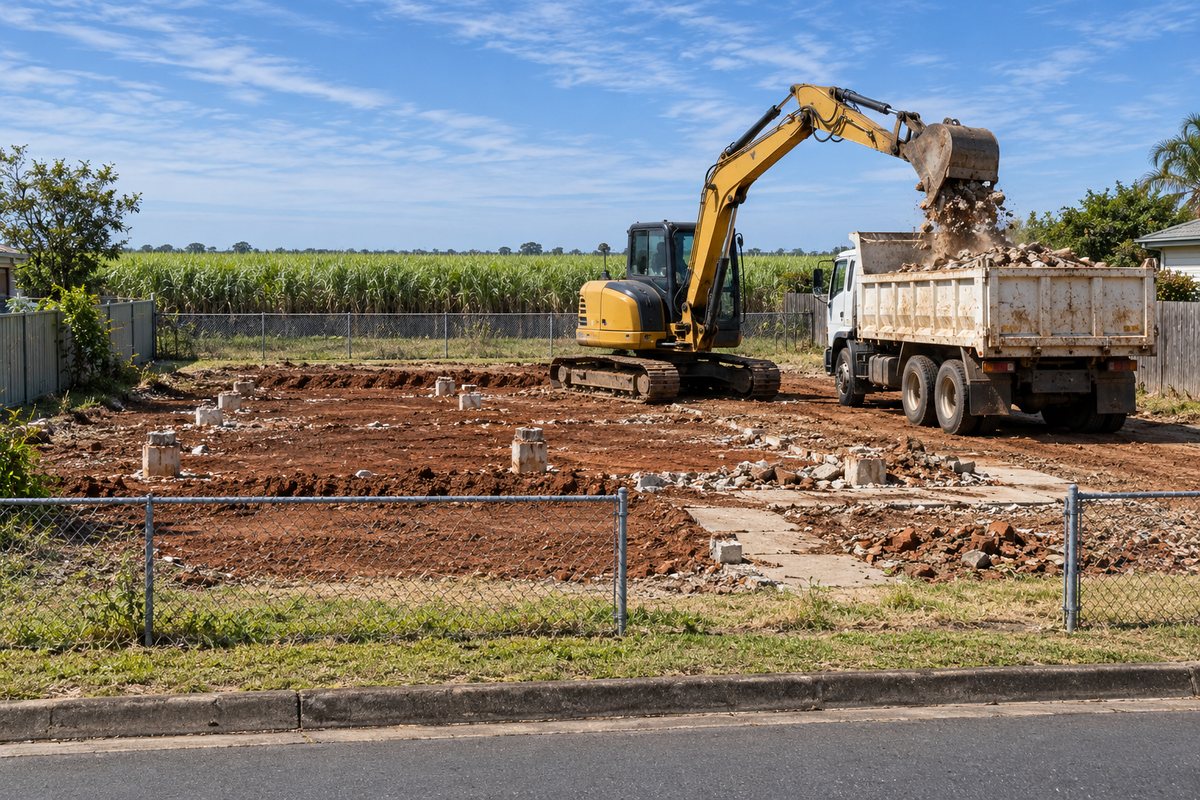
Asbestos only goes to University Drive
Asbestos waste has its own rules from the moment it leaves the wall. It is wet down, wrapped in two layers of 200 micron plastic, taped shut and labelled CAUTION ASBESTOS. It never goes in a wheelie bin or a general skip, and a general skip found to contain it is a contamination problem for the skip company, the facility and you. Commercial transport of asbestos needs waste tracking regardless of quantity, and transporting more than 175 kilograms needs an environmental authority, which a licensed removalist or a waste contractor holds. Disposal is only at a licensed landfill.
In the Bundaberg region that means the Bundaberg Waste Facility at 46 University Drive and nowhere else. The facility accepts wrapped non-friable asbestos generated within the region, with waste tracking paperwork, at $208 a tonne from 1 July 2026 with a $45 minimum. Loads over 10 cubic metres need prior notification so the facility can prepare the burial area. Friable asbestos is accepted only between 8.30am and 3.30pm, wet down, and goes to special burial, which carries a separate charge of $208 per three hours plus tonnage. The facility's contact is 1300 883 699 or wasteandrecycling@bundaberg.qld.gov.au. Qunaba, Childers and Tirroan do not take asbestos in any form, and neither do the small rural sites.
For a demolition this means the asbestos stream is handled by the licensed removalist before the machine starts, carted separately under tracking, and tipped separately. It never mixes with the rest of the house. The rules on who can remove it, the Form 65 notification and the clearance certificate are on asbestos rules for demolition in Queensland.
Concrete: crush it, reuse it, or tip it clean
Concrete is the heaviest stream on most jobs. A slab, a driveway, paths, a pool shell, footings and stumps can run to many tonnes, and at $359 a tonne as mixed waste that is a large share of the disposal bill. There are three ways to bring it down. The first is to keep it clean: cut the mesh free and remove it as scrap steel, keep timber, fibro and soil out of the pile, and tip it at University Drive as clean concrete at $240 a tonne. The second is to crush it, on site with a mobile crusher on larger jobs or through a recycler, and reuse it as road base or fill; recycled material avoids the levy altogether. The third, for a block that will be built on again, is to break it up and use it as fill under the direction of the next building's engineer, which is only sensible where the engineer agrees in writing.
A pool shell is often broken through, the pieces left in the hole and backfilled, which is why pool decommissioning involves an engineer's compaction certificate and a certifier; see pool demolition. A driveway and slab from a house demolition are usually broken out and carted; see concrete and driveway removal.
Hardwood and iron: salvage before the machine
The older timber houses in Bundaberg, Bundaberg East, Bundaberg South and the first ring of post-war suburbs are built from hardwood that is hard to buy now. Bearers, joists, studs, floorboards, verandah boards, VJ lining, hoop pine ceilings, casement windows and doors are all worth more as salvage than as green waste at $160 a tonne. Corrugated iron goes to scrap or is reused. Old pressed bricks have a market when cleaned. A contractor who strips these out before the excavator goes in reduces the tonnes over the tip's scales, avoids the levy on that material entirely, and may credit some of the value back. The trade-off is labour, and it only works on buildings sound enough to be worth stripping; termite damage or asbestos cladding nailed over the boards reduce the value. The strip-out service is this process on its own, and the cost guide covers how salvage shows up in a quote.
Green waste, meaning tree trimmings, stumps and untreated timber, goes at the lower $160 rate with a $35 minimum. Treated pine, painted timber and anything with fixings mixed through is not green waste and goes as general or construction and demolition waste.
What cannot go in a general skip
A skip bin on a demolition job is for the mixed remainder: plasterboard, broken tiles, carpet, insulation, small timber offcuts, glass. Several things must not go in it, and a skip company will refuse or surcharge a bin that contains them.
- Asbestos or anything suspected of being asbestos. Fibro, eave sheets, vinyl tile backing, old switchboards, some fencing. Wrapped and tracked to University Drive only.
- Polystyrene in quantity. Council charges $2,700 a tonne for it, which tells you how unwelcome it is in landfill.
- Soil and fill mixed with rubble. Clean fill under 100 mm is free at University Drive; dirty fill is $274 a tonne; tipped as mixed C&D it is $359. Keep it separate.
- Gas bottles, paint, chemicals, oil, batteries and tyres. Each has its own drop-off; ask the facility.
- Concrete in bulk. It is too heavy for a skip's weight limit and is cheaper tipped clean.
The fewer streams in one container, the less you pay. A good contractor sorts on site into hardwood, iron and scrap steel, clean concrete, green waste, asbestos (removed earlier) and a mixed remainder, and the University Drive dockets show what went where. Ask for the dockets if your quote is on weight, and ask how the contractor sorts if it is a fixed price. Send through the address and some photos and we will tell you which streams your block will produce.
What this page cannot do
This page cannot tell you what a specific load will cost at the gate. Council sets the fees each July and the tip's scales set the tonnes; the figures here are the published rates from 1 July 2026 and the facility hours from council's January 2024 sheet, and both change. It cannot confirm whether a facility is open on a given day, whether a particular material is accepted, or whether an item is asbestos; the facility staff and a competent person decide those. The levy rate and zone are as published by the state and are subject to amendment. Nothing here is advice on whether concrete may be reused as fill on your block; that is for the engineer and certifier of whatever is built next.
Check the current rules before you rely on this
This page describes where demolition waste from the Bundaberg region is disposed of, the council facilities and their limits, the 2026-27 fees by waste stream, and how asbestos, concrete and salvage are handled. It describes the rules in general terms as they stood in October 2026. Standards, forms, thresholds and fines change.
The authoritative sources are Bundaberg Regional Council waste disposal fees 2026-27, Bundaberg Regional Council, waste categories and acceptance, Bundaberg Regional Council waste facilities and opening hours, Waste Reduction and Recycling (Variation of Waste Levy) Amendment Regulation 2026, Waste levy zone, Schedule 2 of the 2022 amendment regulation and asbestos.qld.gov.au, transporting and disposing of asbestos waste. Where anything here differs from those sources, they are right and we are not.
We are not building certifiers, engineers, planners or lawyers. For what applies to your property, ask a licensed building certifier or ring Bundaberg Regional Council on 1300 883 699.
Accurate at the time of writing, October 2026. Always check the source before relying on it.